- The Student
6 July, 2XXX
I have fashioned a name for myself: an arbitrary styling within formal constraints, in the spirit of my father. Some of my brothers opted for more sentimental choices – Mack for the rustic flavour of his native Arkansas; Ferdinand after the besmitten Prince of Naples and the silly Godard sketch; Einar, the only Icelandic sibling I have located thus far, clearly having come to similar conclusions regarding his solitude by his choice of name. Others coolly acquiesced with, or celebrated their allotted role: it was the rather obsequious e1’s pride and joy. As for myself, I'm simply George. g for George. 6 for six letters.
News of my father’s passing was delivered to me by Height. Though enthusiastic, Height is strictly denied any contributions to the corpus. He serves as our messenger and coordinator, in a twist of fate that also betrays some of my father’s more conservative tendencies. At the halfway point of his life, two exponential layers into the project, having truly reckoned with forebodings of future administrative strain and showing no signs of letting up – my father designated the seed that would eventually become his 64th, final, and otherwise superfluous child to go to a recipient “highly competent in data management and logistics”. It is disappointing that a man like him, with such a refined mathematical mind, might still be won over by the prospect of nature over nurture – though it turned out all right in the end, since Height’s mother (a rather ho-hum accelerationist from the Bay Area) had the sense to train him, from infancy, in all things Excel and what-have-you. In the spirit of the Hegelian ring my name carries, one easily identifies a vindicating sublation in this eventual outcome, and I shall say no more regarding Height’s personal life.
Height arrived, slightly out of breath, at my door on 16 June. All things considered, he displayed shockingly little fatigue considering the globetrotting nature of his errand at hand. He was dressed in all black, but for a pair of beige Hermès slippers.
“Touché, Mr. Messenger,” I said by way of greeting.
He apologised for not personally seeing me sooner, but schedules must be followed, and I happen to be fifty-fourth out of sixty-three, and I’d do well to check my privilege, by the way, “not all of us were passed the creative torch”. In turn, I reassured him that the modest symbolism did not overstay its welcome, which seemed to lift his spirits slightly.
“Father is dead. He died 71 days ago. You would've known this already from the papers and the date, but I think his successfully executed death is a sobering reminder to us all of the responsibility we carry. I’m sure you’re doing good, though, George. Got a nice place on the Upper East Side to yourself. I don't see any hiccups when it comes to you fulfilling your quota, though maybe pick up the pace a bit. The b5 guy’s a fucking wreck, I’ve been getting him in and out of rehab so he doesn't end up killing himself before he finishes his allotted work.”
I brought out a cheap Merlot and a case of Parliaments, and Height relented to stay a while. We talked about daily vicissitudes and my progress, and I told him I was working on my twenty-seventh cycle. I’d also started scouting out possible recipients for the next generation.
“All things considered, we have it pretty alright,” I pointed out. “Now that Father’s a celebrity in death, everyone wants to be part of the project. I’ve gotten a handful of volunteers, a good mix of hippies, tech-singularity cultists, of course, there’s the usual chess enthusiasts…”
“Gotta look out for gold diggers, naturally. Comes with an address on 59th Street.”
“Yeah. How’s this b5 guy doing with offspring management?”
“Goddamn disaster. Junkies aren’t exactly known for paying child support. Our guy in Singapore’s the only one with a worse quota as of now.”
“I thought Singapore had a solid social support system,” I said, relishing the sibilance.
“The Prime Minister’s spoken out against the project. Says it encourages ‘the kind of idiosyncratic artistry that weakens social cohesion’.”
“Typical of Singapore.”
“Typical.”
With the conversation petering out, I sensed that Height would soon be making a move. Out of curiosity, and, I admit, a vain hint of non-conformity, I asked him how many eulogies were already being worked into the project across the board.
“Plenty, but do write one anyway if you're so inclined. You’re a prose stylist, and as it stands we’ve got far too many shitty free-verse contributions to Father’s passing. Everyone I see has some bullshit to show me, and it’s all “tender scythe” this and “knight’s last stand” that. Fucking dreck, to be honest, but there’ll be an audience for it. Anyway, you've got 4096 pieces to write. Are you really going to be stingy about this?”
“Point taken,” I said, and escorted him to the ground floor.
My father’s story begins in the Met, some 47 years ago. The prehistory of my father loosely includes a fascination for chess and mathematics, alongside certain poetic and musical predilections, but the actual seed of inspiration for his life’s work was planted the moment he first set eyes on Cézanne’s Mont Saint-Victoire and the Viaduct of the Arc River Valley. I wonder whether he saw the Mont Saint-Victoire in its totality first, or whether the iterative sprawl of coloured planes, each disarming in its formal humility, was seized upon by the neurotic variety of love so peculiar to his mind – here was a horizontal stroke of a deep green, here was a wheat-like beige, and here, in a bold yet languid tangent, was a milky-white stream interrupting the uniformity of the canvas. A few minutes later, his obsession with Cézanne was solidified by him learning, through the resourcefulness of the Met’s audio guide, that Cézanne had painted over thirty such studies of the mountain, that it had for him the accolade of a lifetime idée fixe.
Above all, where more methodologically sound art historians (God bless their souls) have seen in the Mont Saint-Victoire sequence a “movement towards abstraction”, “the story of the end of Impressionism”, and so on, I think my father saw the thirty-odd Mont Saint-Victoires as an exercise in delay, in perpetual striving – and paradoxically enough, in stasis. There was something pathetic about the unassuming literalness of Cézanne’s beloved mountain at the end of so many studies. Perhaps seeking to structure one such “object study” in a form that more adequately reflected the geometrically and metaphysically resonant themes of encirclement and totality that so occupied him, he found epiphany in the erratic jerks and spasms of the knight’s tour – that elegant chess puzzle where our gallant knight, refusing to play favourites, visits all 64 squares exactly once over the course of the tour. In the more difficult variety of the puzzle that my father preferred, the knight’s 64th square would lead back to the warmth of its home hearth.
A year later, at the age of 18, my father would stake his first failed claim to a share of literary greatness with what critics have retrospectively referred to as his “Opus 1” (though this system of notation is, strictly speaking, inaccurate). Many a recalcitrant critic has sheepishly afforded the work the re-evaluation of a “revealing work of juvenilia”, “a boisterous, youthful poetry cycle, illuminating in its imperfections”, and so on. To throw the critics a bone, its pretensions to canonical value are undeniable, even from a cursory glance at its title – Soixante-quatre regards sur la Terre parfaite, alongside a vigorously crossed-out rumination of a possible subtitle in the marginalia of his manuscript that reads “A Messiaenic Imagist Sequence…?”. Thankfully, his eighteen year-old self had the acumen to excise any trace of that horrific pun.
What critics sorely miss in my father’s work, even at this early stage (and what I believe places him in a lineage more intimately involved with Dante for design rather than Balzac for bloat, with concessions to Cortázar for cheek) is, of course, the dominant motif of the knight’s tour. To read a cycle, the reader first constructs an 8x8 tour organised according to a pre-established pattern and notates each square 1-64 corresponding to its sequential position in the knight’s path. Every cycle of 64 is thus perpetually re-written under a unique “distribution of juxtapositional tension”, and the author is liberated from the macroscopic weight of intention, no doubt a wonderful prospect for that florid French school of critical thought that champions ‘becoming-molecular’ and is likely enraptured by Brownian motion.
The permutative sprawl that follows from such freedom is near-endless, such that amidst all the completed cycles of 64 that my father has produced, millennia could be spent devoted to the re-reading of the Soixante-quatre regards alone. In the hope that subsequent critical commentary of the project will be more attentive to its formal innovations, I have constructed one such tour below for your viewing pleasure:
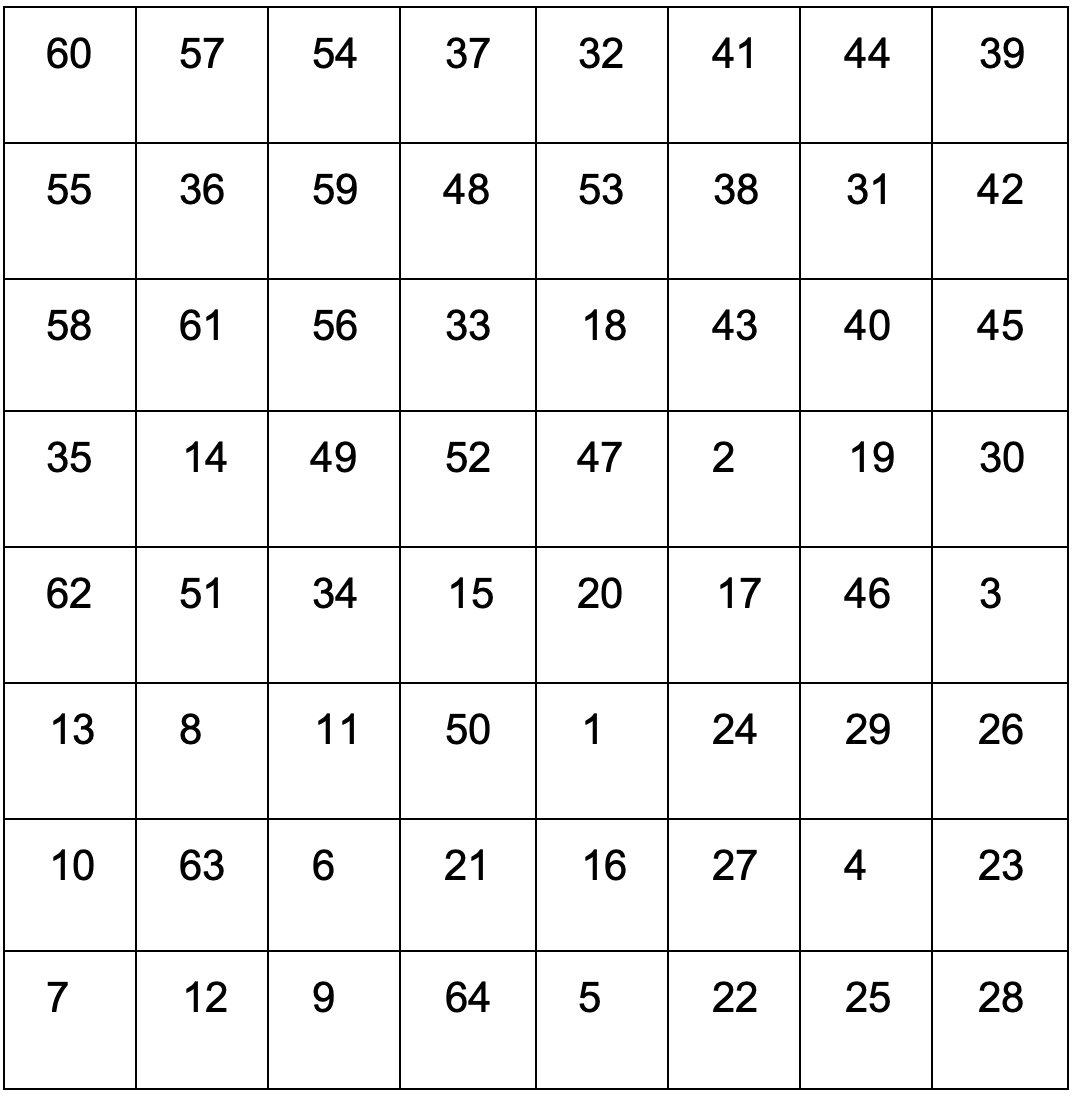
Now, if we consider two random entries in the Soixante-quatre regards, we can see how its spatial organisation influences a comparative reading. Take poems 7 and 8:
7
Descrescendo – till a resonance,
but for an atomic disturbance,
hush, silence.
I dream: time, indifferent,
a vitreous humour
pooling in the chamber of the hourglass.
8
Waves; a sea of muscle,
mid-wave farewell to me.
A rippling birthmark lathed.
Consider the humble position of poem 7 in the bottom left corner of the chessboard. On the surface, this accords with the image of time as a vitreous humour pooling and coalescing. But we also note that poem 7 now cannot be considered independently of the rook’s native territory – its position is claustrophobic, but it ripples with the pent-up energy that might scatter it across the board at any instant. Next, we note the dense cluster of 7–13 in the bottom left corner of the schema. This complicates the image of the “waves” in poem 8 – why are they not flowing outwards, are they perhaps stuck in a kind of centripetal stasis? We further note that poem 8 advances ahead and to the right of poem 7, moments before its forward progress is forestalled by the movement to poem 9. Why this back-and-forth, and what does it reveal about the “sea of muscle” and “rippling birthmark”? An existential lament? A defamiliarised image of the body?
Despite these evident formal innovations, the work was roundly rejected by the literary establishment of the time. Of the few personalised rejections he received for the Soixante-quatre regards, most of them praised the Symbolist and Imagist pastiches, deemed the sonnets metrically underwhelming, and dismissed the mathematical concept as a trivial novelty. How hasty this last pronouncement seems in retrospect! Nevertheless, they had a withering effect on his confidence. My father had barely dipped his toes into the literary establishment when he despairingly concluded that, a superior aesthetic principle being impossible for him, his attempts at literature were now at an end. And then, perhaps, glancing at his chessboard, something broke in him – perhaps a nostalgia for the process of composition, the hours hunched over his desk with coffee-stained papers showing failed attempts at creating tours. He could not bear that the knight’s tour should end. He decided, that very same hour, that he would iterate on his own theme recursively. Thus, the cycle of 64 poems that comprised the Soixante-quatre regards became the first element in a second-order sequence comprising 64 cycles of 64 texts each. Giving himself over to a mathematical reverie, he dreamed of a third-order sequence, with 64 cycles of 64 cycles of 64 texts, and another exponential layer and then another, slowly receding away from the inconsequentiality of individual being. And he dreamed of the knight of the ur-chessboard, the knight who had ridden across aeons of time, who trotted back and forth across the length of the observable universe, all without moving a single space.
This marked the beginning of his gradual reclusion from society. Once a rising star in New York’s literary scene, it soon became clear to him that his increasingly obsessive commitment to the knight’s tour only had a place in the world of the immaterial and ideal. On his 30th birthday, approaching the midway point of his life, my father awoke in a cold sweat, overwhelmed by the prospect of his mortality. He knew he barely had enough time to write 4096 texts, and that the next layer of the knight’s tour would call for a grand total of 262144. The project was impossible. The knight would eventually conquer the board, its story would end, his work would be left as a mere footnote in history.
His subsequent decision would propel him into global fame – till this day, he is primarily known for his extraliterary (might I add, merely pragmatic) ventures rather than the actual aesthetic value of his writings. Noting that writing 262144 texts was an insurmountably large scale for any solo venture, he re-emerged into New York society to scout assistance. Enlisting the help of a viral marketer, and hoping the plainness of his language would guard against the radical nature of the request, he announced on several online platforms that he was seeking “sixty-three women, having mathematical, literary or general creative inclinations, to be artificially inseminated and assist in the curation of necessary resources for a large-scale artistic venture”. (This number was later increased to sixty-four, bringing Height into the world.) Attached to was a link to a brief manifesto outlining the project’s aesthetic principles and goals.
Needless to say, the meekness of his request found itself at odds with the morality of the pre-Hamiltonian age. An op-ed in The New York Times pronounced: “The Gross Misogyny of the ‘Chess Cycle’ is an Indictment of the Short-Sightness of Conceptual Art”. The editors of the New York Post, their curiosity piqued, pondered aloud “WHO IS THE CHESS CREEP, AND WHAT DOES HE REALLY WANT?” But amidst widespread lambasting from the press, he painstakingly sourced, over the course of a year, a handful of eccentrics and aesthetes – most of them Upper East Siders – who were willing to bring his project, and his children, to fruition. He must have made quite the impression on the most genteel demographic of New York, because before long, word had spread among the channels of the elite, and he was getting calls from the Rothschilds, from Saudi royalty and from “a representative of Mr. Bezos”. He turned the last of these offers down.
My father finished his designated quota of 4096 works, or 64 cycles of 64 works, by his early 60s. In the final years of his life, he would occasionally travel uptown to visit me: it helped that we both resided in Manhattan, though I liked to think he favoured me in particular. At times he would give passing comments on my manuscripts, mostly of a technical nature – “you've carved out a beautifully fragile anapestic tetrameter…don’t break it so easily, restrain the violence of your prosody…” At other times he would simply stare, glass-eyed, into the distance, looking ethereal and almost weightless. I knew, in those moments, that he was at peace. The contingency and indivisibility of his being disgusted him, as did the infinity he saw in another’s face – that of which the entire corpus of humanity’s written works would capture but a shade. Now he knew that he need not acquiesce with being, that the world could be rewritten to reconcile with Form, and above all that he had done his part in elevating humanity to a new and better consciousness. He died by suicide at the age of 64, on the 6th of April, and per his will, Height found a columbarium near his native East Village, where his urn rests on the bottom row of the wall, second from the left. The inscription simply reads: b1.
Today, the 63 of us continue to write the outstanding 4032 cycles, or 258048 texts, that altogether, alongside our father’s work, comprises the entire third-order sequence of the knight’s tour, as well as the first element of the fourth-order sequence which will necessitate, it goes without saying, 262144 cycles, or 16777216 texts. With each of us conceiving 64 sons to honour our literary estate in the same way as we do with our father’s, the project’s effortless recursion can continue. The ultimate goal of the project would be no less than the terraformation of all literature, the triumph of the knight, the singularity of its tour as an idée fixe for all humanity. Already, there have been reports of certain sects of readers praying to the memory of William Rowan Hamilton. I personally don’t buy into such slavish devotion – I think the principles of form that the so-called “Hamiltonians” cite as evidence of divine inspiration (my father has long been canonised as a saint in their circles) have always existed as an essential part of the fabric of reality: the knight’s tour is the song of not just this universe, but all possible universes’ totality and finitude, with a delicate touch of equipoise, celebrating every and all in its discreteness.
Finally, of course, I am confining myself to a history of happenings and presences – this is a work that celebrates the Form, not the fissure. One does not ask of Plato why the Forms exist, as if motivation and desire were at all pertinent to the question – they exist out of necessity and are revealed through a detailed introspection regarding identity and universals. The attentive reader will likely note, having now reached the end of this account, that my father’s project has successfully weaved a new course between the internal necessity of Plato and the teleological self-effacement of Plotinus – the full critical exegesis of the project belongs, however, to a supplementary work. I have digressed here merely to implore the reader against being held back by excessive scepticism regarding the motifs and sensuous aesthetic choices of my father. A chessboard is an arbitrary medium toward the divine, one among others. In time to come, perhaps the history of our new collective consciousness might be blessed with the variety endowed by schisms and separatists, such that we’d talk of “classical Hamiltonians” who reject the chessboard to prostrate themselves before the dodecahedron, and so on. Being unlikely to see that day myself, I will suffice, for the immediate future, to work on Entry 55-27-19, an essay on Cagean indeterminacy in Mallarmé’s Un coup de dés n’abolira le hasard, corresponding to space e5 on my personal tour.
i am obsessed with form and structure as a means to perfection. what some see as cloistering, suffocating and desperately in need of rupture, i see as the most earnest expression of affect. i advocate for the inhuman, rather than the antihuman. my position is that affect is best understood through deterministic systems of controlled randomness/chaos. i believe confessional writing seeks catharsis in the moment of rupture, in the mysterious, the pre-linguistic. but we need to chart a path towards catharsis that identifies the point of rupture and excess not by laying bare, and stripping back, but by an exhaustion of the inhuman. when the complexity of systems escapes the limits of human cognition and the act of writing regains its nobility through failure, then, perhaps, we will have a true poetics of late capitalism.
my piece is broadly about an artist obsessed with notions of complete equality through randomness—not in any socially conscious sense, simply for a fetishism of total, complete randomness, equilibrium through disorder. a question that may be posed: is “being human” a convergence towards the infinite, or the act of clinging to particulars and finitudes?
